Bringing card blocking into the voice assistant for Sber's 100M users

Bringing card blocking into the voice assistant for Sber's 100M users

Bringing card blocking into the voice assistant for Sber's 100M users

INDUSTRY:

INDUSTRY:

FINTECH · BANKING

FINTECH · BANKING

YEAR:

YEAR:

2021

2021

EXPERIENCE:

EXPERIENCE:

PRODUCT DESIGN

PRODUCT DESIGN

01. Context

Sber is Russia's largest bank with 100M+ active retail clients. Even minor user experience issues result in millions of support requests annually.

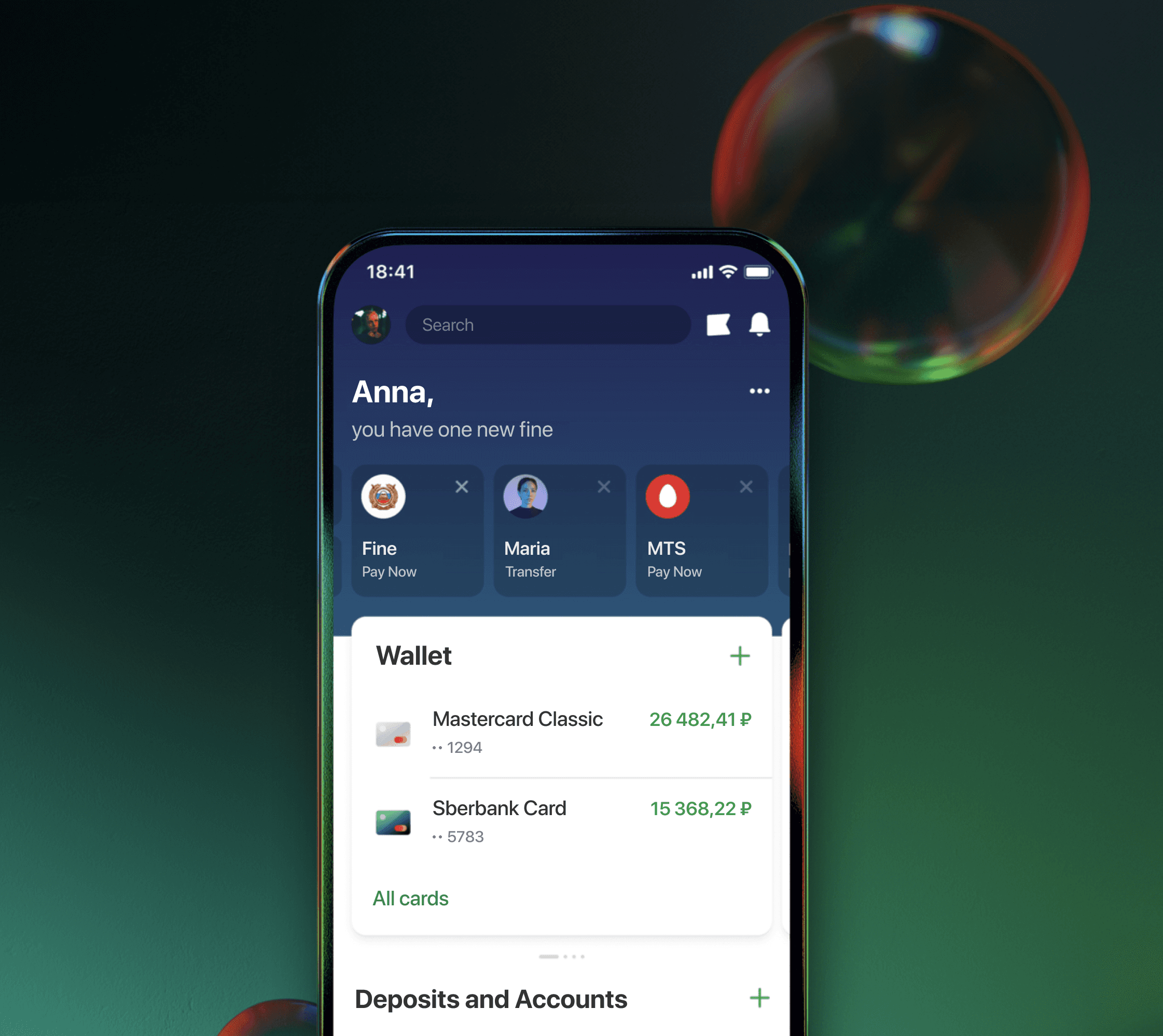
Sber has built a digital ecosystem where the Salyut voice assistant connects smart devices (TVs, speakers, tablets), smart home, and banking services. In the SberBank Online mobile app, users can manage their finances by voice – check balances, make transfers, and pay bills.

My role – Product Designer in the Customer Wallet tribe. I designed self-service banking features that reduce support load and give users more autonomy and clarity.

Sber is Russia's largest bank with 100M+ active retail clients. Even minor user experience issues result in millions of support requests annually.

Sber has built a digital ecosystem where the Salyut voice assistant connects smart devices (TVs, speakers, tablets), smart home, and banking services. In the SberBank Online mobile app, users can manage their finances by voice – check balances, make transfers, and pay bills.

My role – Product Designer in the Customer Wallet tribe. I designed self-service banking features that reduce support load and give users more autonomy and clarity.

Sber is Russia's largest bank with 100M+ active retail clients. Even minor user experience issues result in millions of support requests annually.

Sber has built a digital ecosystem where the Salyut voice assistant connects smart devices (TVs, speakers, tablets), smart home, and banking services. In the SberBank Online mobile app, users can manage their finances by voice – check balances, make transfers, and pay bills.

My role – Product Designer in the Customer Wallet tribe. I designed self-service banking features that reduce support load and give users more autonomy and clarity.

02. The challenge

02. The challenge

Card blocking is critical and often needed in inconvenient moments – driving, in panic, or away from the phone. The app handles most scenarios, but support tickets revealed a gap: users still call the contact center when reaching the app is hard, spending 5+ minutes on hold and ID checks.

Sber was developing the Salyut voice assistant ecosystem (smart speakers, in-car integration, SberBoom devices). The opportunity: extend card blocking into voice, so users could act the moment they need to – hands-free, instantly, by command.

The challenge: design this for one of the most sensitive banking operations, when the user's money is at stake.

Card blocking is critical and often needed in inconvenient moments – driving, in panic, or away from the phone. The app handles most scenarios, but support tickets revealed a gap: users still call the contact center when reaching the app is hard, spending 5+ minutes on hold and ID checks.

Sber was developing the Salyut voice assistant ecosystem (smart speakers, in-car integration, SberBoom devices). The opportunity: extend card blocking into voice, so users could act the moment they need to – hands-free, instantly, by command.

The challenge: design this for one of the most sensitive banking operations, when the user's money is at stake.

03. Discovery

03. Discovery

To understand how users interact with voice assistants in critical situations, I conducted discovery research including interviews and usability testing. This revealed key barriers: deep distrust of voice technology from past frustrating experiences, and fundamental misunderstandings about what "blocking" means.

Еo understand how users interact with voice assistants in critical situations, I conducted discovery research including interviews and usability testing. This revealed key barriers: deep distrust of voice technology from past frustrating experiences, and fundamental misunderstandings about what "blocking" means.

When I called (SberNumber), sometimes the assistants are too scripted, and they might not understand something, which is inconvenient.

"I prefer doing things manually. My daughter uses voice control, but I don't." Voice assistants perceived as toys, not serious tools.

Two respondents used voice control only in navigation (Yandex Maps): "I see voice control as a gimmick."

Another viewed Siri as a toy: "It misunderstands, and I have to redo things. The technology is still at a low level."

04. Problem

04. Research
of the problem

I mapped the current blocking process and built a CJM to see where it broke. The pattern was clear: to block one card, people called support, waited on hold, and pushed through extra steps. Slow for them, costly for the bank.

So I redesigned around the ecosystem Sber was already building. Card blocking belonged in the voice assistant: fewer steps, fewer calls, action the moment a card goes missing.

Another viewed Siri as a toy: "It misunderstands, and I have to redo things. The technology is still at a low level."

05. Mockups and Testing

05. Mockups
and Testing

I designed the voice flow end to end: pick the card, give a reason, confirm, done. The assistant speaks each step, the screen mirrors it word for word, and the user can talk or tap at any point. I built it to hold up across three real situations: a lost or stolen card, a card captured by an ATM, and a card someone just wants to pause.

I designed the voice flow end to end: pick the card, give a reason, confirm, done. The assistant speaks each step, the screen mirrors it word for word, and the user can talk or tap at any point. I built it to hold up across three real situations: a lost or stolen card, a card captured by an ATM, and a card someone just wants to pause.

06. User testing

06. User testing

I partnered with the UX research team to test the flow with 5 SberBank users over Zoom, walking each through three real scenarios:

  1. You have several Sber cards. You have lost your card and your passport. What do you do?

  2. You have several Sber cards. An ATM has captured one. What do you do?

  3. You have one Sber card you will not need for a few months. What do you do with it?

[ 01 ]

[ 01 ]

Insight

Users perceive the term “card blocking” as an irreversible process and are afraid to use it if they only want to not use the card for a while.

[ 02 ]

[ 02 ]

Insight

Users spoke the command for the voice assistant with the phrases they saw on the screen.

[ 03 ]

[ 02 ]

Insight

The status of the card (blocked or not) is checked by users on the main screen.

[ 04 ]

[ 02 ]

Insight

Users first pronounce the command with their voice, and then if the voice assistant does not react, they will click on the suggested options on the screen.

07. Second Iteration

07. Second
Iteration

I conducted a second round of research to test several hypotheses, including the "Temporarily Block" suggestion. Key findings:

  • 4 respondents didn’t notice the suggestion but found it useful after explanation.

  • 2 respondents suggested all block reasons should be in a single list.

  • 1 respondent felt that "Temporarily Block" should be integrated into the main list for clarity.

  • 1 respondent tried clicking the suggestion instead of using a voice command.

08. Outcomes

08. Outcomes

I shipped card blocking inside the voice assistant, designed for real situations, not just the happy path: move money off the card first, open a new card if it was the user's only one, then block.

/ In the numbers

0%

Support Requests

0%

Task Completion